
Transformation Memoir · The book
This Isn’t Random
Uncover the Hidden Patterns Shaping Your Life - and Change What Happens Next
You keep telling yourself you are not going to do this again. And then somehow, you are here again. The same relationship dynamic. The same shutdown. The same exhaustion you swore you had finally outrun. What if it is not random, and what if trying harder is not the answer, because the pattern was never a character flaw to begin with?
In This Isn't Random, Dr. Iolanda Johnson draws on her own story, from chemical engineer at Intel and the woman holding every calendar, every bill, and every family need together, to the moment she stopped asking "How do I fix this?" and started asking "Where did this come from?" What she found underneath was not weakness. It was a set of intelligent, learned responses, each one built in a specific season of her life, each one doing exactly what it was designed to do.
Through the Excavation Method, readers learn to look beneath present-day reactions, trace repeating patterns to their roots, and interrupt automatic responses before they run the day. This book is for any woman who has solved the same problem more than once and quietly wondered why it keeps coming back.
Get your copy
The central idea
High-functioning women cannot permanently break the patterns of perfectionism, people-pleasing, burnout, and overwhelm that exhaust them by trying harder, planning better, or using more willpower - because those patterns are not character flaws but learned responses with identifiable root causes; lasting change only becomes possible when a woman learns to excavate the origin of her patterns, understand what they were once protecting her from, and then consciously choose to build something new in their place.
Look inside
Read the opening pages
Sunday mornings were supposed to feel like rest. Instead, I would wake up with my chest already tight, the dread already settling in. I did not have to go to work until Monday. My mind was already running through the week ahead: the deliverables, the meetings, the emails I had not answered over the weekend. I had been managing homework and meals and bath time and everything else that falls to a mother when she is, for all practical purposes, on her own. The twins were still small. Their older brother needed things too. At the time, I felt that Intel did not care what my home life looked like. What mattered was whether I had the answer. Whether everything under my ownership was running smoothly. Whether I could shine.
Every year, we had what was called a brag sheet. We had to list out the things we had done that year. We needed to shine in order to even be considered for a promotion. The culture rewarded visibility. It rewarded self-promotion. And I was a woman who had spent her entire life working hard in the background, believing that if I did enough, someone would notice.
They did not notice.
I went sixteen years without a promotion.
Sixteen years of delivering, performing, solving, and carrying. Shrinking myself small enough to avoid drawing the wrong kind of attention. Because that was what I knew how to do. I did not know it had a name yet. I did not know it was a pattern. I knew that something inside me kept pulling me back into the same posture: head down, work hard, do not make waves, do not take up too much space. Then wonder why nothing changed.
By the time Sunday morning came around each week, I was already spent. I would get to the point of being in tears. I could not concentrate. There was an overall sense of dread that hung over everything. I did not want to go to work. But I could not afford not to. I was a single mother with no safety net. The only place I could try to get relief was through work, because I could not take a break from the kids. I would press my way through fall, through winter. By springtime it would really start hitting. By May, I would hit that brick wall. Every year. The same wall. The same month.
I did not yet see the cycle. I kept walking into it.
If you had looked at my life from the outside during those years, you would have seen a woman who had it together. An engineer at Intel. A mother of three. A woman who showed up, handled her business, kept things running. I managed the finances, the school activities, the household, the emotional temperature of every room I walked into. If something needed to be done, I did it. If someone needed something, I gave it. That was the deal. That was the unspoken contract I had been living under since I was a child.
I had my armor on. I had it on for so long that I did not remember ever not having it. The armor looked like competence. It looked like responsibility. It looked like a woman who could handle anything. But underneath it, I was exhausted in a way that no amount of rest could reach. I had fatigue that rest couldn't cure.
My ex-husband was controlling. And I stayed. I stayed the way I had learned to stay. By giving more. By trying harder. By making myself smaller so there would be less to criticize. The more I gave, the more he took. I was carrying all the weight financially, spiritually, emotionally. I kept thinking that if I could just get it right, if I could just figure out the combination of effort and sacrifice that would make things work, the pressure would ease.
It did not ease.
I had been married about thirteen years when the stress of the marriage and the stress of Intel and the stress of managing twins and an older son alone all collided. I had so much on me. And my husband was not with me. Not absent in the dramatic way people picture when they hear that. Present in the house, but checked out from the partnership. I was doing everything alone inside a marriage.
That intersection (the marriage not going well, the constant pressure at work, the feeling of being stuck) was where the weight became more than I could carry in silence. Not the kind of collapse that happens all at once. The kind that builds slowly, load by load, while you keep performing as though nothing is wrong. Because that is what you have always done. Because that is what you were taught.
I was the oldest child. A sensitive child. Always trying to please.
My father was a strict disciplinarian. He was not necessarily physically abusive to me, but what I witnessed between him and my mother I can only describe as physical and verbal abuse. And for me, the message was consistent: good was never enough. I could have done a hundred things correctly, but if I got one wrong, that one erased everything else. I learned early that love was conditional on performance. That safety depended on anticipating what someone else needed before they had to ask. And that my feelings were not welcome in the room.
He did not allow a show of emotions. Going to my grandmother's funeral, going to my grandfather's funeral, he had a problem with us showing sadness. He felt that it was weakness. Any show of emotion other than being happy. You were supposed to not let the world know that anything was wrong.
So I learned not to let the world know. I learned to hold everything inside my body and keep moving. I learned to shrink.
My mother spent a lot of time doing damage control before damage...
That is the end of the free preview
Get the full chapter free by email, or get your copy today.
Enter your email to get the full chapter as a PDF.
Your place is saved if you come back later.
Inside the book
Chapter by chapter
01 The Woman Who Has Tried Everything +
We meet Iolanda as the capable, credentialed, quietly exhausted woman holding a career at Intel, children, finances, and everyone else together, while something underneath keeps fraying.
02 The Smoke Was Never the Fire +
The central shift: every symptom she had been treating was smoke, not fire. She introduces the move from 'How do I fix this?' to 'Where did this come from?' and what it unlocked.
03 Holiday Dread and the Things We Inherit +
The first personal excavation: holiday dread she had dismissed as personality quirk, traced to the domestic instability and patterns she inherited from childhood.
04 Looking for My Father in Every Room +
The relationship pattern examined: the pull toward emotionally unavailable people that carried the shape of her father's absence, and the grief that came when those relationships fell short.
05 Sixteen Years in the Shadow of the Factory Floor +
Sixteen years at Intel, gravitating toward work that kept her out of the spotlight. Iolanda maps how a fear of authority figures, learned early, quietly and expensively shaped her career.
06 May, Again +
Iolanda notices something remarkable in her own records: year after year, across very different years, she was reaching a breaking point in May. The chapter sits inside that recognition.
07 The Engineer Who Listened Differently +
The pivot: Iolanda recognizes that the root-cause analysis she performed on chemical systems at Intel was the same work she had always done intuitively with people, and names it.
08 What the Casino Was Really Giving Her +
A client arrives wanting help with casino visits. Following the thread backward, Iolanda and the client find a deeper layer underneath, showing the Excavation Method at work in practice.
09 Everyone Was Failing Her (Until She Saw Why) +
A client convinced others kept letting her down discovers, through excavation, a pattern of trying to control outcomes that was making connection impossible. A harder and more useful truth.
10 Armor +
Patterns that wear the face of strength: the controlling or intimidating exterior that turns out to be armor over fear and unresolved experience, not power.
11 What They Called Laziness +
Iolanda turns the lens on her own household and recognizes that what she had been reading as laziness in her son was actually overwhelm, showing how excavation changes what we see at home.
12 The Door You've Already Walked Through +
The close: not a triumphant list but a quality of seeing. Iolanda reflects on no longer trying to fix a version of herself she now understands was never broken, and what the reader carries forward.
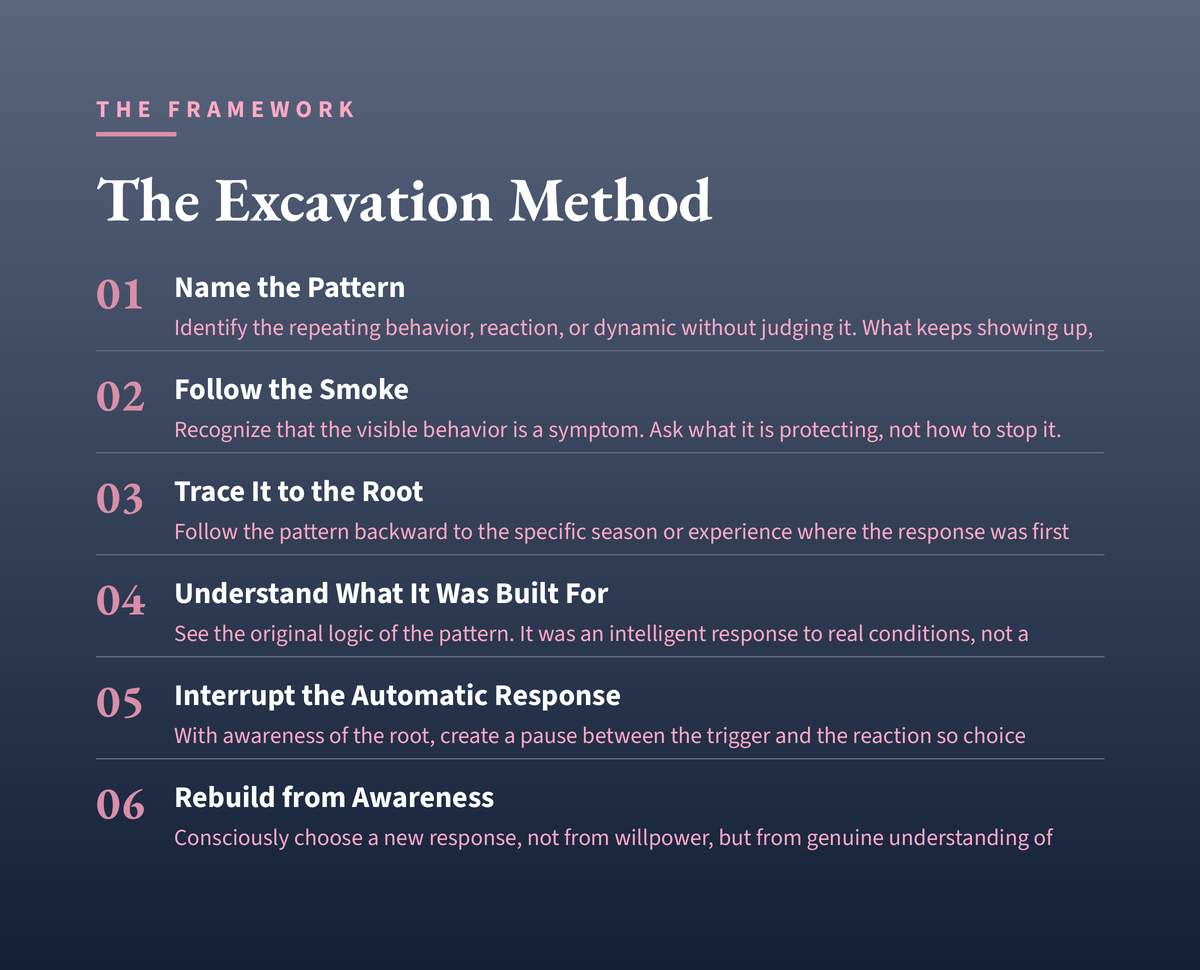
The framework
The Excavation Method
Ask the book
Questions this book answers
Why do I keep repeating the same patterns even when I genuinely want to change?+
Because the pattern was never a failure of effort or character. According to DrJ, the behaviors that exhaust us most, overcommitting, perfectionism, emotional shutdown, were each learned in a specific season of life and built to protect us from something real. Until you understand what a pattern was originally doing for you, trying harder to stop it is like treating smoke instead of the fire underneath it. Permanent change requires finding the root, not increasing the pressure.
Chapter 2
What is the Excavation Method and how is it different from regular self-help?+
The Excavation Method is DrJ's framework for tracing a present-day pattern backward to its original root cause, the specific experience or season that taught you to respond this way. Rather than offering strategies to manage behavior, it asks where the behavior came from and what it was protecting. DrJ developed it by recognizing that the root-cause analysis she had practiced on chemical systems as an engineer was the same work she had always done intuitively with people and her own life.
Chapter 7
Isn't this just about blaming my childhood or my parents?+
DrJ addresses this directly: excavation is not about assigning blame to your parents, your past, or yourself. It is about understanding the past clearly enough that it stops making decisions for your present. The patterns she maps, including her own relationship with her father's absence, are framed as intelligent responses to real conditions, not evidence that anyone is broken or at fault. The goal is awareness and choice, not grievance.
Chapter 4
What if my pattern looks like a strength, not a problem?+
Some of the most important excavation work happens beneath what looks like capability or control. DrJ writes about patterns that wear the face of strength, the intimidating exterior, the relentless drive, the need to manage everything, and how these often turn out to be armor over fear or unresolved experience. The question is not whether a pattern looks functional but whether it is costing you more than you want to keep paying.
Chapter 10
How do I know if what I am seeing in someone else is their pattern or just who they are?+
DrJ explores this through her own family, describing the moment she recognized that what she had read as laziness in her son was actually overwhelm. When something feels enormous to him, he cannot break it down. The same excavation lens that applies to ourselves applies to the people we live with. Seeing the root changes what is possible in the relationship, because you stop responding to the surface behavior and start responding to what is underneath it.
Chapter 11
Can this work even if my patterns are not tied to dramatic trauma?+
Yes. DrJ is careful to frame root causes as experiences from specific seasons of life, not necessarily catastrophic events. A pattern can begin in something as ambient as chronic instability, a parent's emotional absence, or a workplace environment that rewarded silence. The Excavation Method is designed to follow whatever thread is actually there, not to require a particular kind of story as the price of admission to understanding yourself.
Chapter 3
I feel blank. Therefore, I do blank.